Saturday, August 23, 2008

Pericles and the Treasuries


In Thuc. II.13 Pericles gives an interesting survey of the Athenian financial landscape. He lists major sources of revenue:

  1. contributions from allies - 600 talents
  2. coined silver stored in the Acropolis - 6,000 talents
  3. uncoined gold and silver offerings made by individuals and the state
  4. sacred vessels and furniture used in the processions and in the games
  5. spoils taken from the Persians
  6. money kept in other temples
  7. gold from the statue of Athene herself (forty talents removable)
Pericles makes it clear that all these sources should be used in the Athenian's time of crisis. Thucydides paraphrases Pericles' argument:

"...the strength of Athens came from the money paid in tribute by her allies, and victory in war depended on a combination of intelligent resolution and financial resources."

Clearly the money is for military purposes, not religious propitiation.

Saturday, August 16, 2008

Faith and Leadership

This article on the presidential candidates relates to my research. Are Obama and McCain truly religious? Who knows. But they clearly feel pressured to appear so.

Saturday, August 2, 2008

Religion and People

Parker on religion:

Even the philosophers (when not thinking theologically) constantly see religious practice as a medium of association not between man and god but between man and man. (1)


Parker's Athenian Religion is an important source for learning about Athenian religious practices. He persuasively shows that religion was very much about community and the experience of doing something together, socially. This is consistent with philosophical theories on religion in any time period.

The social value of religion is important for me because it helps show the power of religion as a motivating tool. People accused of religious violations, such as Alcibiades, were being accused of violating social rules, too. As such they ran the risk of not just being religiously punished, but of being socially ostracized. Indeed, a common punishment for religious violations not considered bad enough to warrant the death penalty was a ban from religious ceremonies, and thus from much of the socializing of Athens.

Tuesday, July 29, 2008

Expenditures

This is what I'm reading about currently, and I need to learn a lot more about it.

Broadly speaking, the Athenians spent money in several different areas: military, religious institutions, religious and civic festivals/feasts, and city projects and "beautification." There is much more specific information out there, though, and I'm hoping to quantify these categories (and all the rest I have forgotten to list here). If I can quantify them I can see which were receiving the majority of the money, which has obvious religious implications.

What I'm testing for is where the money went and whether the expenditure was of rational use to the Athenians. For example, if I find much of the money going towards the military, with the justification being that the gods support their military campaigns, then this is support for my ideas. If, however, I see them continuing to spend money on things like temple-upkeep even when they are in the middle of a massive war and are running out of money for their military, this may undermine my arguments.


Is this where the money went?

Monday, July 28, 2008

Sources of Funding


5th Century Athenian Money (clark.edu)

To examine how religion influenced financial decisions, it's important to look at where the money originally came from. How the Athenian "government" (nothing like what we call a government today, I imagine) obtained revenue would obviously affect how the money was spent.

In Empire of the Owl: Athenian Imperial Finance, Samons details many of these sources. A significant portion of Athen's income came directly from its silver mines. Some also came from conquest in war, some from donations by individuals to the gods. There were also numerous forced "tributes" (read: taxes) imposed on people, particularly on foreigners, earmarked for the Athenian gods and stored, naturally, in the temples. At some times there were also property and sales taxes.

We know also from the Attic Stelai (and I would guess from other sources) that property could be confiscated for crimes, particularly for religious crimes.

Many of these tax receipts must surely have obligated the collectors. If a government is collecting religious taxes, surely much of the revenue must go towards, or at least appear to go towards, religious expenditures. Certainly a lot of money was spent on religious functions (I'll save that for a future post), but again I think the flexibility of the religion comes into play. Politicians could argue that whatever they were spending the money on, for example a military campaign, was a proper and therefore pious expenditure. If the gods control everything but leave it up to the Athenians to make certain decisions, then shouldn't they be willing to let some of the tax revenue go towards those decisions?

Two Forms of Funding

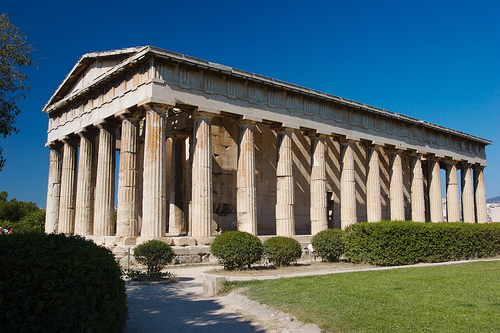
Temple of Hephaestus (wikisource)

In theory, the Athenian government (such as it was) collected taxes for two distinct purposes: hiera, sacred matters relating usually to specific deities, and hosia, a word with debated meaning. Some scholars see hosia as something like the opposite of hiera, catching all non-religious uses of funds. But, almost all are careful to explain, the Greeks had no concept of separating expenditures into religious and non-religious categories. hosia in fact means something like "sanctioned by the gods" (according to the Great Scott), so it can't have really been much removed from religious matters.

What the use of hosia suggests to me, if we can take it to pertain to divine sanction of some kind, is that the spenders of the money clearly had to show that anything Athens spent money on was pious, and therefore sanctioned by the gods, even if it was tabbed for ostensibly non-religious purposes like war against Sparta.

Adding further complication, funds designated as hiera could be spent, in times of crisis, on non-religious matters. Clearly the distinction was less than absolute.

Either way, the presence of these ideas shows that people in Athens in charge of spending money had a significant obligation to establish the piety of their actions - an important fact to keep in mind when analyzing decisions made during the Peloponnesian War.

Divination Ignored

Though this example is only useful to my argument by analogy, since it does not concern the Peloponnesian War, it's too good not to write down.

Publius Appius Claudius Pulcher was a rich Roman and a general.  Before an important naval battle, he was compelled to consult the sacred chickens.  As the superstition went, if the chickens ate the food put out for them, the gods approved of the battle and the fleet could attack.  If the chickens did not, however, the battle must be put off.

For whatever reason, the chickens did not eat.  Exasperated and eager for battle, Claudius Pulcher grabbed the chickens and flung them into the sea, exclaiming (or so the story goes), "if they will not eat, well, let them drink!"  He then attacked.  

This story captures much of what my thesis is about - divination was a convenient thing, but, at least for leaders, not powerful enough to dissuade them from greater plans.  Pulcher was going to attack that day, signs be damned.  

Also tellingly, Pulcher's men were reluctant, being more superstitious than the patrician.  When the Romans lost the battle, Pulcher's impiety was blamed.  According to this amusing website (which I have not verified in any way), Pulcher's relative was even fined later for daring to suggest that other Roman armies would have been better off with him in charge.  

Athenian Treasuries


Athenian Treasury at Delphi (utexas.edu)


Currently my research is focusing on how the Athenian government procured funding during the Peloponnesian War. This has important applications to my subject because much of this money came from religious sources. A great deal of money was kept within particular temples and religious sites, and the receipts of many Athenian taxes went directly to these places. During times of crisis Athens could "borrow" money from these temples, and I think normally they repaid these debts.

Thus if a politician wanted to undertake a costly expedition like, say, invading Sicily, he would need to get money from "the gods." Therefore it would be very much in his interest to appear pious. An impious politician is unlikely to get much money out of the temples, since every action was seen by the Athenian people, who would not look kindly on impiety.

Here, as in all the instances I've examined, I see the same force at work - it doesn't matter whether the politician has religious beliefs. He is completely hamstrung by the beliefs and superstitions of the Athenian people, and he can only act with their consent.

But it goes both ways. The politician, hampered by their beliefs, can also use them to his own advantage. He can use their religious superstitions to slander an opponent by accusing him of impiety. He can argue that certain courses of action are impious, or, alternatively, that his proposed course of action is indeed the most pious. The key is the flexibility of Athenian religion - their actions are not always dictated by straightforward divine signs and omens. They must use their brains to interpret what the gods want, which leaves plenty of room for debaters on all sides to argue that their plan must be the one the gods like best.